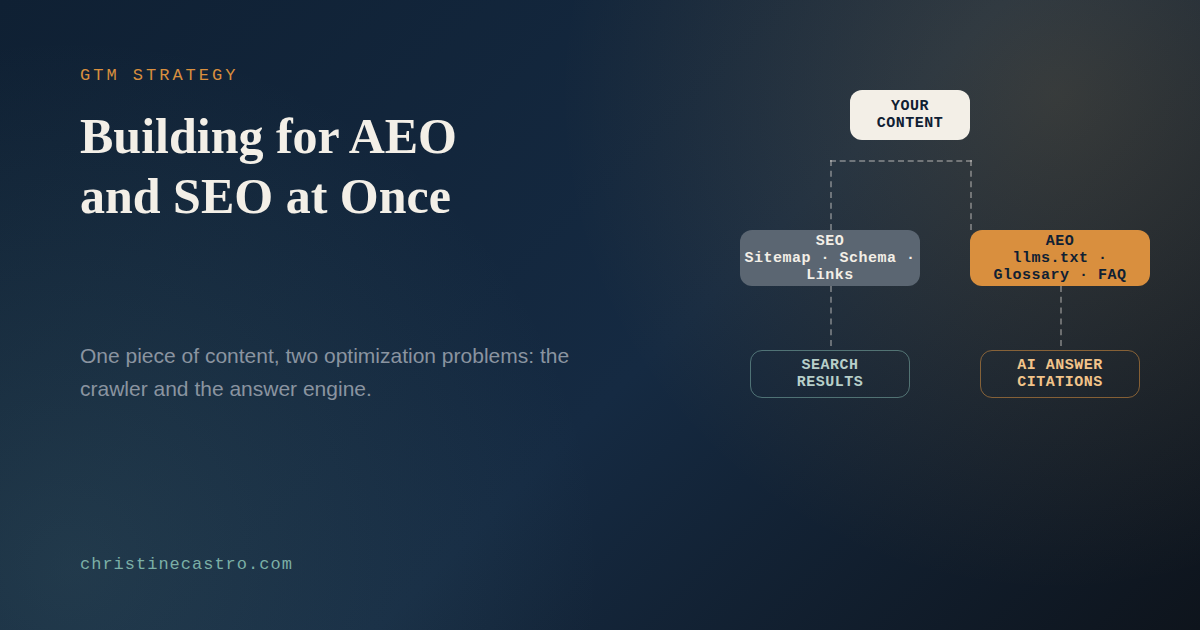
Roughly 75% of B2B search queries now enter through AI answer engines, Perplexity, ChatGPT Search, Google AI Overviews, rather than a traditional search results page. That single statistic changes what a website actually has to be built for. A page can rank well in classic search and still be invisible to the systems increasingly standing between a buyer and your site, and a page built purely to get cited in an AI answer can still fail to rank anywhere a human is scrolling. These are two different optimization problems, and most companies are still only solving one of them.
I led a full website redesign this year for a security intelligence company built explicitly around this dual-track approach: architected for the classic crawler and the LLM at the same time, as two distinct disciplines with their own tactics, not one SEO checklist with a few AI buzzwords bolted on. Here's how that broke down in practice, and how to apply the same framework to your own site.
Quick answers
What is AEO?
AEO stands for answer engine optimization: structuring content so AI systems like ChatGPT Search, Perplexity, and Google AI Overviews can extract a clean, accurate answer and cite your page as the source. To implement it, write short, self-contained answer blocks with specific data points at the top of key pages, and mark up definitional content with schema an AI system can parse directly.
What is AIO?
AIO, AI optimization, is often used interchangeably with AEO and covers the broader practice of making a site legible to AI systems generally, including training crawlers and inference-time retrieval, not just live answer-engine queries. In practice the implementation overlaps heavily with AEO: structured schema, an llms.txt file, and clean, unambiguous definitional content.
What is an llms.txt file?
It's an emerging standard, structurally similar to robots.txt, that gives AI crawlers a direct, structured summary of a site's content instead of forcing them to reconstruct one from scattered pages. To implement it, publish a plain-text file at yoursite.com/llms.txt listing your most important URLs under clear section headers, plus a short Key Concepts block defining what your company does and the terms specific to it.
What is a DefinedTermSet and DefinedTerm?
These are schema.org structured data types used to mark up a glossary. A `DefinedTermSet` represents the glossary as a whole; each `DefinedTerm` represents one entry inside it, with its own name, definition, and URL. To implement it, add JSON-LD markup to your glossary page that wraps the full term list in a `DefinedTermSet` and tags each individual term as a `DefinedTerm` with an anchor-linked URL.
What is FAQPage schema?
It's a structured data type that marks up a visible question-and-answer section so search and AI engines can identify and potentially surface individual Q&A pairs directly in results. To implement it, write the FAQ content as real, visible text on the page first, then add JSON-LD markup that mirrors that exact text. Structured data with no matching visible content is discounted by most engines.
What is a BreadcrumbList?
It's a structured data type that marks up the navigational path to a page, for example Home > Blog > this post, so search engines can display that path as clickable sitelinks directly in a search result instead of just a bare URL. To implement it sitewide, generate the breadcrumb trail programmatically from your site's actual navigation hierarchy and output matching JSON-LD on every page, rather than hand-writing it per page, which drifts out of sync as pages move.
What is robots.txt, and how does it relate to the sitemap?
robots.txt is a plain-text file at the root of a domain that tells crawlers which parts of a site they're allowed to access. It also supports a Sitemap directive, a line pointing crawlers directly to your sitemap.xml. To implement it correctly, make sure that directive is actually present and pointing to the live sitemap URL, since a sitemap that exists but isn't referenced from robots.txt is easy for crawlers to miss entirely.
What is a bottom-funnel, high-intent query, and what makes a comparison page work for it?
A bottom-funnel query is a search from someone actively comparing named options right before a decision, like "[Your Company] vs [Competitor]," as opposed to broad, early-stage category research. To implement a comparison page that captures it, use a consistent URL pattern like /compare/yourcompany-vs-competitor/ across every comparison page, and write direct, specific comparisons rather than vague category positioning, since both searchers and search engines reward specificity on these queries.
AEO and AIO: building for the answer engine, not the results page
Answer engine optimization starts from a different question than traditional SEO. Traditional SEO asks how a page ranks for a query. AEO asks whether an AI system can lift a clean, accurate, attributable answer out of your content and cite you as the source, instead of synthesizing a generic answer from wherever it can find fragments.
Build a glossary as authority infrastructure, not a content-marketing afterthought. For this project, that meant a 79-term glossary with DefinedTermSet and DefinedTerm JSON-LD schema on every single entry, FAQPage schema layered on top of the twenty highest-traffic terms, and anchor-linked URLs so an AI citation can deep-link straight to the exact definition rather than dumping a reader on a long page and hoping they scroll to the right section. The company also owned several genuinely proprietary terms, concepts nobody else in the category had defined in public. That matters more than it sounds like it should: when an AI engine needs to answer a question involving one of those terms, there is exactly one authoritative source to cite, because no competing definition exists anywhere else on the web. My own cybersecurity marketing glossary runs on the same logic at a smaller scale, over 300 terms, server-rendered for indexability, with a suggestion form so the term list keeps growing instead of going stale.
Deploy an llms.txt file. This is the emerging standard for giving AI crawlers structured, direct access to what a site actually is and does, distinct from a traditional robots.txt file, which governs crawler permissions rather than content summarization. The file we built listed 30 verified URLs under structured section headers, plus a dedicated Key Concepts block written specifically to feed a language model the definitions it needs to answer a basic "what does this company do" query accurately, rather than guessing from scattered marketing copy. The direct payoff is fewer hallucinated or generic answers on branded queries, because the model has a clean, structured summary to draw from instead of reconstructing an answer from fragments.
Write a standalone AEO answer block at the top of every solution and comparison page. This is a short, self-contained paragraph, specific enough to include real proprietary data points, not just category-generic claims, and short enough that an AI system can lift it directly into a synthesized answer without needing to interpret or trim it. On this project, those answer blocks carried specific figures like exact record counts and exposure percentages that only this company could cite, which is precisely what separates an answer engine quoting you from an answer engine quoting whichever generic blog ranked highest that week. A vague, well-written paragraph is worse for AEO than a precise, slightly less polished one with a real number in it.
Traditional SEO: still the discipline that gets you found in the first place
None of the AEO work above replaces classic SEO. A page an AI engine would love to cite still needs to be crawlable, indexed, and structurally sound, or it never enters either system's consideration set to begin with.
Build competitor comparison pages that target high-intent, bottom-funnel queries. These are the pages for buyers who are already evaluating alternatives by name, not the buyers still researching the category in the abstract. Use a consistent, predictable URL pattern for every comparison page, something like /compare/yourcompany-vs-competitor/, because search engines reward that structural consistency for comparison-style queries, and it makes the page's intent unambiguous to both a crawler and a reader.
Standardize the boring stuff sitewide, because it compounds. A consistent title tag suffix across every page. Consistent navigation, including dropdown and resource-menu entries that actually match what's live. BreadcrumbList schema sitewide, which is what supports sitelinks showing up under your listing in search results rather than a bare blue link.
Build a sitemap.xml with real priority weighting, not a flat list. Weight priority by actual conversion value, a homepage and your one or two primary buyer entry points at the top of the priority scale, stepping down for lower-value pages like careers. Submit it to Search Console, and make sure robots.txt actually contains a Sitemap directive pointing to it, since a sitemap nobody's pointed a crawler toward is just a file sitting on a server.
Why these two tracks reinforce each other instead of competing for resources
The strongest argument for building both tracks at once is that they aren't actually separate investments, they're the same content doing two jobs. The glossary that exists for AEO citation purposes also generates dozens of internal links into product and solution pages, each one a qualified entry point from an informational query into a commercial conversation, which is a traditional SEO and conversion benefit, not just an AI-citation benefit. The comparison pages built for bottom-funnel search intent are exactly the kind of specific, well-structured content an AI engine can also cite cleanly when a buyer asks it to compare two named vendors. Building for one discipline in isolation leaves real value on the table that the other discipline would have captured for free.
Being honest about what "results" means immediately after a launch
A site that just launched doesn't have months of Google Analytics or Search Console data to point to yet, and it's worth resisting the temptation to report vanity numbers that don't exist yet or, worse, invent softer metrics to fill the gap. What you can report honestly, immediately, are the structural signals the build actually produced: every proprietary term now has your company as the sole authoritative definition source available to AI engines, meaning any citation on those terms routes back to you by construction, not by luck. Comparison pages are indexed and targeting named-competitor queries at a moment when those specific queries often have no strong incumbent ranking yet, which is a real, if early, opportunity window. The llms.txt file gives AI training and retrieval systems a clean, structured summary of your full product surface, which directly reduces hallucination risk on branded queries, an outcome you can reason about immediately even before traffic data comes in. And the glossary's internal link structure is measurable the day it ships, dozens of qualified entry points from informational content into commercial pages, regardless of whether the organic traffic numbers have caught up yet.
Framing results this way, structural and strategic rather than borrowed vanity metrics, is also just more honest, and it holds up better under board or leadership scrutiny than a traffic number that hasn't had time to mean anything yet.
A working checklist to build this for your own site
For AEO and AIO:
- Build or expand a glossary of terms your category actually searches for, with
DefinedTermSet/DefinedTermschema on every entry andFAQPageschema on your highest-value terms. - Identify and explicitly define any genuinely proprietary terms or frameworks your company owns, so AI engines have exactly one place to cite.
- Publish an llms.txt file with verified URLs, structured section headers, and a Key Concepts summary block.
- Add a short, specific, data-backed answer block at the top of every solution and comparison page, written to be lifted directly into a synthesized AI answer.
For traditional SEO:
- Build named-competitor comparison pages on a consistent URL pattern, targeting bottom-funnel, high-intent search queries.
- Standardize title tag structure and navigation consistency sitewide.
- Implement
BreadcrumbListschema sitewide. - Build a sitemap.xml with conversion-weighted priority, submit it to Search Console, and confirm robots.txt actually points to it.
This is exactly the discipline behind how I've built out my own glossary and tool pages, including GTM Radar, the Pipeline Coverage Calculator, the Budget Scoping Tool, and the GTM Hiring Scope Builder, structured schema, anchor-linked terms, and a sitemap and robots.txt maintained every time a new page goes live, because the same framework that works for an enterprise security site scales down to a single-operator GTM tool suite just as directly. If you want a structured read on where your own site's AEO and SEO foundation actually stands before you invest further, that's exactly the kind of gap my GTM Alignment Diagnostic is built to surface.