The short answer: Both a fractional CMO and a full-time marketing leader can be the right call. Full-time makes more sense when the gaps are clear and the company needs someone building a team and owning the function every day. Fractional makes more sense when the gaps are unclear, the work is a defined project, or the company needs senior judgment before it can support a full executive package. Map the gaps first, then choose.
When scoping out the structure of the organization, most companies, at some point, ask a version of the same question: Do we bring in a fractional CMO, or do we hire a full-time marketing leader?
Both are good answers, for different situations. A fractional leader brings senior judgment scoped to the work in front of you. A full-time leader brings daily ownership, a team that grows around them, and a long-term stake in the outcome. The expensive mistake is choosing before you know which situation you’re in.
I’ve built marketing functions as a full-time leader at venture-backed security companies and as a fractional VP, so I don’t have a stake in steering you toward either one. I can just tell you where things differ with the roles, and how I’d make the call.
Quick answers
Should a startup hire a fractional CMO or a full-time CMO?
Both can be the right call. Full-time makes more sense when the gaps are clear, the company needs someone building and managing a team every day, and it’s ready for a long-term executive with equity. Fractional makes more sense when the gaps are unclear, the work is a defined project, the company needs senior judgment quickly, or its stage doesn’t yet support a full executive package. Map the gaps first, then choose.
What are the main differences between a fractional and a full-time marketing leader?
A fractional leader works under a contract scoped to the work, can start in weeks, and carries no equity, benefits, bonus, or search fee, and brings pattern recognition from several companies. A full-time leader owns the whole function every day, builds and manages the team, builds context that compounds inside the company, and is tied to the outcome through equity. Neither is a lesser version of the other.
What is a fractional CMO?
A fractional CMO is an experienced marketing executive who leads a company’s marketing under a contract rather than as an employee, scoped to what the company needs. That can be ongoing leadership a few days a week, a defined project, strategy and planning, revenue operations repair, or full-time interim for a set term.
Is a fractional CMO part time?
Not necessarily. Fractional describes the contract, not the hours. An engagement can be two days a week, a single project like a positioning reset, annual planning, a RevOps and attribution repair, or full-time interim coverage. Map the gaps first, then set the scope to match them.
How do you know what kind of marketing leader to hire?
Map the gaps first. List the specific problems, such as positioning that doesn’t land with the economic buyer, founder-dependent pipeline, weak brand and category recognition, thin content, unproductive events or channel, or broken attribution. Match each to what fixes it. Some gaps define the leader’s lead discipline; others call for a specialist, an agency, or an operations hire and shouldn’t drive the leadership decision.
How does a fractional CMO compare to a full-time CMO on cost?
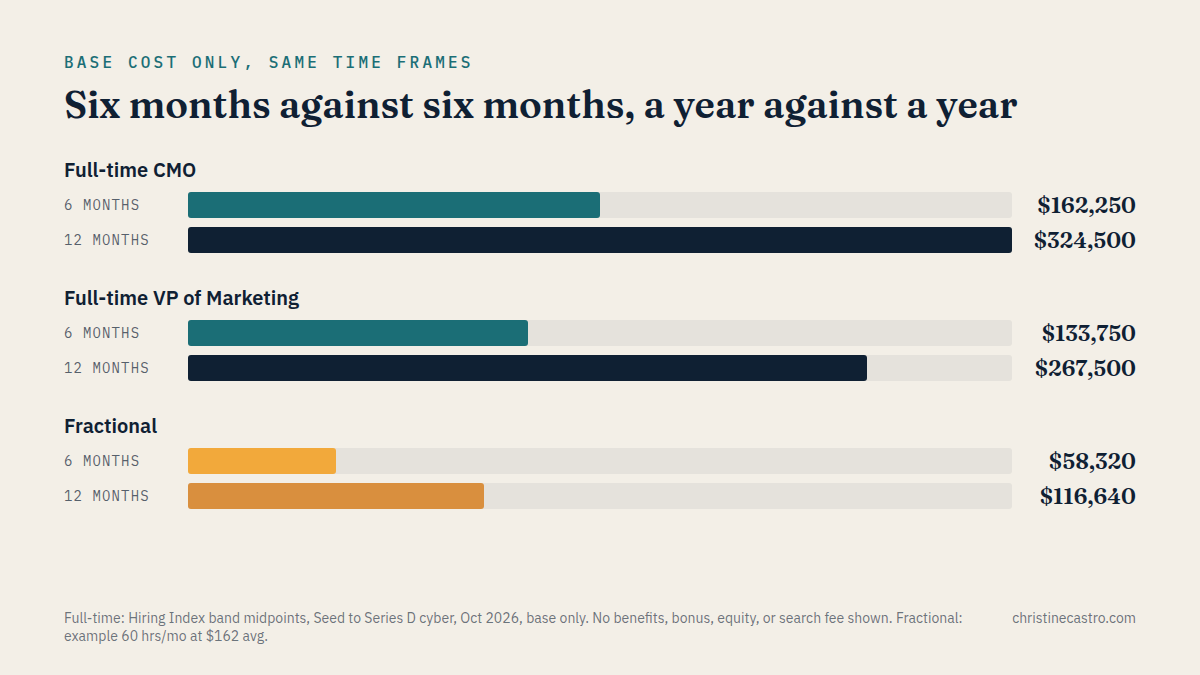
Compared on base pay over the same period, a full-time CMO at the $324,500 midpoint of the Hiring Index band for Seed through Series D cybersecurity companies costs $162,250 for six months and $324,500 for twelve. A VP of Marketing at the $267,500 midpoint costs $133,750 and $267,500. A fractional engagement at 60 hours a month and a $162 average costs $58,320 and $116,640. The full-time figures exclude benefits, bonus, equity, and search fees, none of which apply to fractional.
Is a fractional CMO cheaper than a full-time CMO?
Over the same time frame, yes, by a wide margin, and the full-time side also carries benefits, bonus, equity, and usually a search fee. Per hour, fractional usually costs a little more. The midpoint of the Hiring Index CMO band works out to about $156 an hour, against a fractional average of about $162, which rises or falls with the mix of strategy and execution work.
Should a startup’s first marketing leader be a CMO or a VP of Marketing?
Set the title at parity with the rest of the leadership team and match it to the scope. If sales is led by a CRO and product by a CPO, a marketing leader titled Head of Marketing or Director signals a support function. Marketing needs an equal seat at the table, and the title is part of how that seat is defined.
Who should a full-time marketing leader report to?
The CEO. Marketing works best as a peer to sales with an equal seat at the executive table, so the leader can push back on targets, budget, and ICP. A marketing leader who reports into the CRO tends to end up running a lead factory.
How long do first marketing hires last at startups?
Not long. Research on venture-backed companies has found the average first marketing hire lasts less than twelve months, and one analysis of CMO hiring outcomes put the failure rate at 42% within eighteen months. Most of those failures come from a mismatch between the leader and the role, which is why mapping the gaps and defining the role first matters.
Step 1: Map the gaps and what each one calls for
“We need marketing” isn’t a gap. Before you pick a model, name the specific problems and match each one to what actually fixes it. Some gaps define the leader you hire. Others call for a specialist underneath that leader, an agency, or a contractor, and those shouldn’t drive the leadership decision at all.
Here is the map I use with security companies. Most have two or three of these at once.
| Gap | What you see | What it calls for |
|---|---|---|
| Positioning and messaging | Practitioners like the product, but the CISO who signs doesn’t get it. Every rep tells a different story. Deals stall at the economic buyer. | A leader with positioning depth, or a strategic leader plus a senior product marketer |
| Pipeline | Most deals are founder-sourced. No channel produces repeatable results. Sales and marketing argue about lead quality. | A demand and pipeline-led leader, with a demand generation manager underneath |
| Brand and category | Buyers and analysts can’t place you, so you get lumped in with incumbents. | A brand and category-led leader; an agency can carry comms and analyst relations early |
| Content and thought leadership | Nothing credible to send a prospect. Research and expertise stay in the heads of founders and researchers. | A content lead or managing editor, rarely the leader’s lead discipline unless content is the motion |
| Field and partner | Events don’t produce meetings. Channel partners don’t co-sell. | A field and partner-led leader only if the motion is event or channel heavy; otherwise a field marketing manager |
| Revenue and operations | No attribution, a messy CRM, and board numbers nobody trusts. | A marketing operations or RevOps hire, often before the leader |
Read the right-hand column carefully. If your biggest gaps are operations and content, a full-time CMO isn’t the first hire. If the biggest gap is positioning and the second is pipeline, you need a leader who is deep in one and credible in the other, and you hire depth underneath for the rest.
How confidently you can fill in this table shapes the decision. A clear map that points to one lead discipline leans toward a full-time hire. A map with several gaps, or one where you aren’t sure which gap matters most, leans toward fractional, at least until the picture is clearer.
Step 2: Understand how the two models differ
Neither model is a lesser version of the other. They’re built for different jobs.
| Fractional | Full-time | |
|---|---|---|
| Commitment | A contract scoped to the work, easy to expand, shrink, or end | Employment, open-ended |
| Scope | Set from the gaps: days a week, a project, planning, RevOps repair, or full-time interim | The whole function, every day |
| Speed to start | Usually weeks | A search, an offer, and a notice period, often months |
| Cost structure | Fees for the agreed scope; no equity, benefits, bonus, or search fee | Base plus benefits, bonus, equity, and usually a search fee |
| Team | Can design the team and run hiring, but isn’t there every day to manage it | Builds, manages, and develops the team every day |
| Continuity | Context leaves with the engagement unless it’s written down | Context and relationships compound inside the company |
| Perspective | Pattern recognition across several companies and stages | Depth in one company, its buyers, and its market |
| Alignment | Tied to the scope and outcomes in the contract | Tied to the company through equity and a long-term stake |
Read the table as trade-offs, not a scorecard. The same row can favor either model depending on what the company needs right now.
Step 3: Do the cost math on the same time frame
The fair comparison is base pay against fractional fees over the same period. Here it is at six and twelve months, using the salary bands from my Cybersecurity GTM Hiring Index for the full-time roles and my average fractional rate for the fractional row.
| Base cost only | Six months | Twelve months |
|---|---|---|
| Full-time CMO (band midpoint $324,500) | $162,250 | $324,500 |
| Full-time VP of Marketing (band midpoint $267,500) | $133,750 | $267,500 |
| Fractional, 60 hours a month at $162 | $58,320 | $116,640 |
Where the numbers come from. The Hiring Index puts base salary for a cybersecurity CMO at $262,000 to $387,000 and for a VP of Marketing at $225,000 to $310,000, as of October 2026. These ranges are specific to this space: marketing leadership roles at Seed through Series D cybersecurity companies, benchmarked at a Series B baseline for a remote U.S. role. They won’t match a public company, an enterprise, or a marketing leader outside security. The table uses the midpoint of each band.
The table understates the gap, because it stops at base salary. A full-time hire also carries benefits, employer taxes, a bonus, an equity grant, and usually a retained search fee, which typically runs 25 to 35% of first-year compensation. A fractional engagement carries none of those: no equity, no benefits, no bonus, and no search fee.
The fractional row uses my average rate across strategy, execution, and technical work, about $162 an hour. That average moves with what I’m contracted to do: an engagement weighted toward strategy runs higher, and one weighted toward execution or technical work runs lower. Sixty hours a month is one example scope, not a standard. A two-day-a-week leadership role, a single project, or a RevOps repair will each price differently. You can build your own mix of work and see the rate on the Engagement Planner.
Two notes on that math:
First, per hour, fractional costs a little more. The midpoint of the CMO band works out to about $156 an hour against my $162 average. What you’re paying for is exactly the scope you need, with no long-term commitment, no recruiter fees, no benefits, bonus, or equity, and no severance conversation if the fit is wrong.
Second, cost alone shouldn’t decide it. Fractional costs less over any matching time frame, but if the company needs someone owning the function every day, a cheaper model that doesn’t cover that need isn’t a saving. Use the cost math to compare options that both fit, not to choose the fit.
If you want to model your own version, the Building a Marketing Team tool compares team structures side by side with your budget.
Step 4: Decide which model fits
With the gap map and the trade-offs in front of you, the decision usually becomes clear.
Full-time makes more sense when:
- The gap map is clear and points to one lead discipline.
- The job means building and managing a team every day for the foreseeable future.
- Your motion depends on daily presence in market, like heavy field, partner, and event programs where relationships compound over time.
- The company has validated its market and needs one person to own the marketing number for years, with equity tying them to the outcome.
- You already have a strong candidate who fits a well-defined role. Don’t lose them to run a process.
Fractional makes more sense when:
- The gaps are unclear, or they span several disciplines and you aren’t sure which matters most.
- You need senior judgment now, and a search would leave the seat empty for months.
- The work is a defined project: a positioning reset, a launch, annual planning, or a RevOps repair.
- The company’s stage or budget doesn’t yet support a full executive package.
- The founder still closes most deals and needs a strategic partner more than a department head.
- A capable team needs direction, not daily management.
Some companies run on fractional leadership for a year or longer, and that is a legitimate way to run marketing at that stage.
The two can also work together. A fractional engagement can come before a full-time hire to define the role, or end in converting the fractional leader. A full-time leader can bring in fractional specialists for a gap they don’t cover, like product marketing, RevOps, or analyst relations. The question is what the company needs now, and that can change.
Step 5: Define the role, whichever model you choose
Whether you’re writing a job description or a fractional scope, this is the step founders skip, and it’s where most marketing leadership hires go wrong. The seat turns over faster than almost any other in the C-suite, and at startups the numbers are worse. Research on venture-backed companies has found the average first marketing hire lasts less than twelve months, and one analysis of CMO hiring outcomes put the failure rate at 42% within eighteen months. I broke down where those numbers come from, and what a mis-hire actually costs, in The Real Cost of a Marketing Leader Mis-Hire. Cybersecurity shows the same pattern on the job boards: the Hiring Index counts 98 leadership roles among 633 open marketing positions at pre-IPO security companies, 15.5%, one of the highest leadership shares of any go-to-market function. Most of that churn is a fit failure, not a skill failure, and fit is decided by how well the role was defined.
“CMO” is a title, not a job description. Every marketing leader at an early-stage company is full stack: a broad working knowledge of brand, demand, product marketing, content, field, and operations, and real depth in a few of them. Nobody is deep in all six. The gap map from Step 1 tells you which depth your company needs first and which depth gets hired underneath. That applies to a fractional leader too: hire one whose depth matches the gaps you’re asking them to close.
One pattern worth flagging for security companies. If the gaps run wider than positioning, be careful about handing all of marketing to a career product marketer. Product marketing-led leaders in cybersecurity often come up through engineering and are excellent at messaging, but lighter on strategy, brand, and demand. When the gaps are wide, hire a strategic or demand-led leader and make product marketing a required depth.
Two structural calls belong in the role definition too, and both are about giving marketing an equal seat at the table.
- Title at parity with the leadership team. The marketing leader’s title and scope should be comparable to the other leaders around the table. If sales is led by a CRO and product by a CPO, a “Head of Marketing” or “Director” title tells the company, and every candidate, that marketing is a support function. Match the title to the scope, and set the scope at the level of the peers this person will be planning and negotiating with.
- Reporting line. The role should report to the CEO as a peer to sales, not into the CRO. A marketing leader with an equal seat can push back on targets, budget, and ICP. One who reports into sales tends to end up running a lead factory.
How to Hire for GTM breaks the marketing leader role into six lead disciplines and builds a scoped job description around the one you need, including the depth hires that go underneath.
What mistakes do I see founders make?
- Choosing a model before mapping the gaps.
- Defaulting to full-time because it feels more committed, or to fractional because it feels cheaper.
- Hiring a CMO title to reassure the board before the role has a defined scope.
- Hiring a leader to fix a gap that a specialist or an agency could cover.
- Comparing costs over different time frames, or comparing base salary to fractional fees without counting what full-time adds on top.
- Starting either model with no goals, no baselines, and no review date.
- Choosing a fractional package that fits the offer instead of the problem.
Where should you start?
Whichever way you’re leaning, map the gaps and scope the role first. That work tells you which model fits, and it’s the same work either way. Start with How to Hire for GTM.
If fractional looks like the better fit, Work With Me explains how I run fractional and interim engagements, and the Engagement Planner lets you scope one and see what it would cost.
Sources
- Christine Castro, Cybersecurity GTM Hiring Index, snapshot of October 2, 2026. Base salary bands for CMO and VP of Marketing at Seed through Series D cybersecurity companies (remote U.S., Series B baseline), executive demand index, and employment-type split.
- Christine Castro, The Real Cost of a Marketing Leader Mis-Hire, August 2026. First marketing hire tenure at venture-backed startups, CMO failure rate within eighteen months, and retained search fee range, with the underlying sources listed there.